Posts

A wake-up call for railway industry
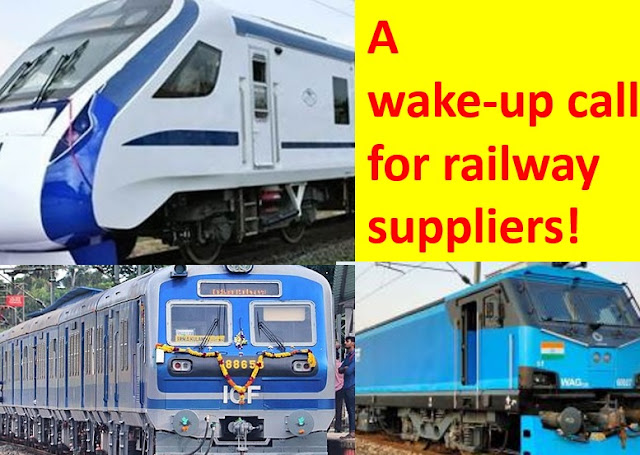
Image
Discussion on deteriorating financial health of Indian Railways(IR) is  passé   and maybe, even irrelevant. Comptroller & Accountant General(CAG) may go on calling out that IR’s finances are window-dressed and it camouflages the reality by excluding pension payments and other jugglery but the government has made up its mind. It is not a question any more whether the plethora of infrastructure projects make sense in the background of lacklustre performance of IR and the competition it faces from road and air. Surely the government is aware of the financial health but it has gone firm in its belief that rail infrastructure is needed for the country’s base of logistics in the economy as a whole and viewing IR’s financial health in isolation in not important, at least in short term. Large-scale Capex, which has mounted steadily since 2014, almost five times from around 50000 cr. to as much as 2.45 lakh cr., is here to stay.   IR has moved at breakneck speed to acqui...

Dil and jigar/the heart and the liver

Image
  Body parts in day-to-day idiomatic as well as street language? Yes, they are used in all languages, certainly in English, Hindi and Urdu. No expletive can be potent, or offensive, enough without liberal use of some body part or the other, as a noun, or even more trenchantly as a verb. While I leave a listing of these cuss words to your cogitation, let me reproduce what Merriam-Webster says about the employment of many parts of the body in either a physical or a metaphorical sense; editor Peter Sokolowski breaks down a number of body parts with metaphorical uses as verbs, from head to toe. https://www.merriam-webster.com/video/body-parts-that-are-also-verbs-head-shoulder-muscle#:~:text=You%20can%20head%20a%20company,line%20you%20might%20get%20skinned . You can head a company, but if things go wrong you'll have to shoulder the blame, or face your investors. A good leader backs their employees, but if you don't toe the line you might get skinned. Did you muscle your w...

Train 18/Vande Bharat Express: Indian Railways Round Up

Image
Indian Railways (IR) is always in the news. Even at the risk of, by now, a cliched repetition, I have to say that IR is a n institution which so many love and so many love to love, some love to hate, and a few actually hate, but none like to ignore.  I, therefore, venture, through a series of blogs, to explore these news items, and add my tuppence to this cacophony of positivity, excitement and unadulterated hype, the good, the bad and yes, also the ugly. My attempt today is simple: check out what is out there about the cynosure of many eyes and a whipping boy for some. Train 18/Vande Bharat express and how genuine excitement has been overtaken by consummate aggrandizement.  A sterling team of brilliant engineers and technicians from Integral Coach factory (ICF) and allied industry came together with great synergy, conceptualized and delivered Train 18/Vande Bharat express in 2018; a near world-class train, made entirely in India in just 18 months at a fraction of what it ...

Good railwaymen get a chance!

Image
  There is a view that the top management cadres of Indian Railways (IR) are in a mess due to half-baked and unimplemented reforms initiated by the previous rail regime without much sense of purpose. A large number of top posts of IR, particularly those of Members of the Board and General Managers (GMs), lie vacant. In the middle of this chaos, came the announcement that all future induction of officers would be through a common examination and the successful candidates would join an integrated service called, Indian Railway Management Service (IRMS). As expected, there was more criticism than support for the move. I also wrote about it in Hindu BusinessLine, 10 th March 2022, with some reservations about the move to have a single cadre at the entry stage, although I had always opined that a unified cadre at top level was indeed a crying need.   No one can downplay the need for a positive resolution of the age-old problem of acute departmentalism and fragmentary working o...